

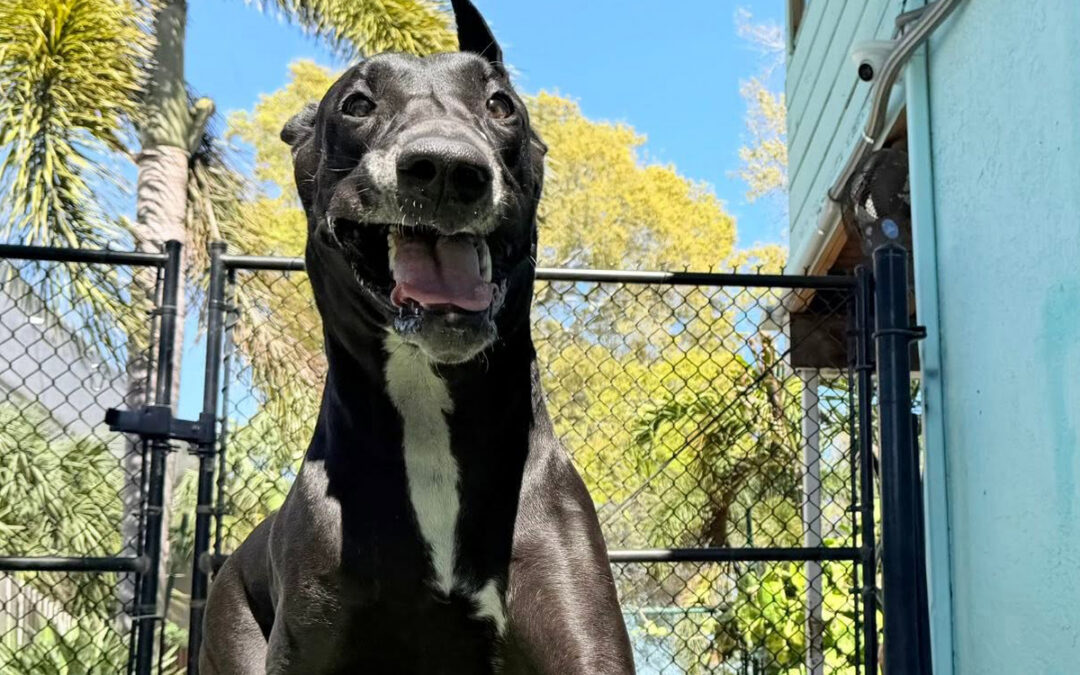
Fence barking is one of the most common behavior problems families deal with in residential neighborhoods.
A dog goes into the backyard, hears another dog, sees someone walking past, or notices activity on the other side of the fence. Within seconds, they may be running the fence line, barking repeatedly, ignoring recall, and becoming increasingly worked up.
In Pinellas County neighborhoods, where homes can be close together and sidewalks, dogs, delivery drivers, and backyard activity are common, the opportunity to practice this behavior can happen several times a day.
The longer a dog rehearses fence barking, the stronger the habit can become. At The DogHouse LLC, professional dog training and boarding focus on teaching dogs how to notice neighborhood activity without feeling responsible for reacting to everything around the property.
Understand Why Dogs Bark at the Fence
Fence barking can come from several different motivations.
Some dogs are territorial and feel responsible for monitoring the property. Others are frustrated because they can hear or see another dog but cannot reach them. Some are excited by movement, while others may be nervous about people or animals approaching the boundary.
The reason matters because the best training plan should address the individual dog rather than treating every barking problem exactly the same way.
The Fence Can Make Reactions Stronger
A physical barrier can change behavior.
Two dogs may be relatively calm in another environment but bark intensely when separated by a fence. The barrier prevents normal movement and can increase frustration.
Once the dog learns that running and barking along the fence is part of the routine, the behavior can become automatic.
The sound of a neighbor dog or footsteps outside may be enough to start the reaction.
Repetition Makes Fence Barking Stronger
Dogs become better at whatever they practice.
If the dog goes outside every day and spends ten minutes running the fence and barking, that is ten minutes of rehearsal.
Over weeks or months, the behavior becomes faster and more intense.
Preventing repeated uncontrolled practice is one of the most important steps in changing the habit.
Supervise Backyard Time
A dog that regularly fence barks may not be ready for unlimited unsupervised yard access.
At least during training, go outside with the dog.
This gives you the opportunity to respond before the barking becomes intense.
You can redirect, recall, or move the dog away from the fence before the full pattern begins.
Act Before the Dog Reaches the Fence
Timing matters.
If your dog hears something and immediately starts moving toward the fence, that is your best opportunity.
Call them before they arrive.
Redirect to another area.
Reward the return.
Once the dog is sprinting the fence line and barking repeatedly, recall becomes much harder.
Early intervention creates better training.
Build a Strong Backyard Recall
Recall is one of the most useful skills for reducing fence barking.
Practice when nothing exciting is happening first.
Call your dog from different parts of the yard.
Reward the response.
Release them again.
The dog should learn that coming to you does not always mean backyard time is over.
Once recall becomes strong in easy situations, begin practicing around mild distractions.
Do Not Repeat Recall Over and Over
If you say “come” five times while the dog continues barking, the cue can quickly lose meaning.
Give the command once when the dog is still capable of responding.
If the dog is not reliable enough yet, use a leash or long line during supervised yard time so you can support the cue.
The goal is building successful responses rather than practicing ignored commands.
Long Lines Can Help During Training
A long line can be very useful in larger yards.
The dog has room to move, but the family still has control.
If the dog starts heading toward the fence, the handler can interrupt the pattern and guide the dog back before barking becomes intense.
This gives the dog more freedom than a short leash while still protecting the training.
Reduce Visual Access When Possible
Some dogs become much more reactive when they can see movement through gaps in the fence.
People walking.
Dogs passing.
Children playing.
Adding privacy material, landscaping, or another visual barrier may reduce the intensity of the trigger.
Environmental management is not a substitute for training, but it can prevent repeated reactions while better habits are being built.
Do Not Encourage Guarding Behavior
Some families unintentionally reinforce fence barking by reacting to it as though the dog is doing a good job protecting the home.
Talking excitedly.
Looking over the fence.
Running toward the sound.
The dog may interpret the family’s response as participation.
A calmer approach is usually more useful.
The goal is teaching the dog that neighborhood activity does not require action.
Avoid Yelling From the Back Door
When the dog is barking outside, owners may shout the dog’s name or yell “quiet” repeatedly.
This often does very little.
The dog may be too engaged to listen, and the added yelling can increase the overall intensity.
Go outside when possible, create clear communication, and guide the dog away from the fence.
Training works better when the dog has something specific to do instead.
Teach an Alternative Behavior
Simply telling the dog not to bark does not explain what they should do.
Give them another job.
Recall to you.
Go to place on the patio.
Move to another part of the yard.
Come inside and settle.
The clearer the alternative is, the easier the dog can learn a different response.
Place Work Can Be Useful Outdoors
If your dog already understands place indoors, the skill can be practiced outside.
A raised cot or mat on a patio can give the dog a defined location away from the fence.
The dog learns to remain settled while normal neighborhood activity happens.
This can be especially useful during times of day when people and dogs regularly pass the property.
Reward Calm Observation
Your dog notices someone on the other side of the fence but does not bark.
That is valuable.
Reward it.
The dog hears another dog and looks toward you instead.
Reward that too.
Do not wait until the dog reacts to begin interacting with them. Calm behavior is the behavior you want to make worthwhile.
Another Dog Barking Does Not Require an Answer
Neighbor dogs can be one of the strongest fence-barking triggers.
One dog barks.
Your dog answers.
Soon both dogs are involved in a daily exchange.
Teach your dog that another dog barking does not require participation.
Recall them away, reward disengagement, and create more distance from the fence when needed.
Fence Running Can Increase the Excitement
Some dogs do more than bark.
They sprint back and forth along the boundary.
The movement itself increases arousal.
Barking gets louder.
The dog becomes harder to interrupt.
Stopping fence running early is important because once the dog is physically activated, calming down becomes much more difficult.
Exercise Alone Will Not Fix Fence Barking
A dog with appropriate exercise may be easier to train, but simply tiring the dog out usually does not solve a learned fence habit.
The dog can be physically tired and still run to the fence when the trigger appears.
The behavior needs specific training.
Exercise supports that process, but it does not replace it.
Give the Dog Better Backyard Activities
The yard should not exist only as a place to patrol.
Structured play, short training sessions, sniffing activities, and time with the family can help change the dog’s relationship with the backyard.
The dog learns that going outside does not automatically mean checking every fence line.
Be Careful With Unlimited Backyard Freedom
Some dogs are given backyard access whenever they ask for it.
If much of that time is spent patrolling and barking, unlimited access may actually strengthen the problem.
More structured outdoor time can help.
The dog goes outside with a purpose, enjoys appropriate activity, and comes back in before the yard turns into a security assignment.
Dogs Can Become Very Aware of Neighborhood Schedules
Dogs learn when certain people walk by.
They may know when the neighbor’s dog goes outside or when delivery drivers usually arrive.
The dog may begin waiting at the fence before anything happens.
If you notice this pattern, use proactive structure during those times.
Bring the dog inside, use place, or supervise the yard more closely.
Delivery Drivers Can Trigger Fence Barking
Dogs may react strongly when delivery drivers walk near the property.
The movement is quick and predictable, and the person usually leaves soon afterward.
From the dog’s perspective, barking may appear to have successfully made the person go away.
This can reinforce the behavior.
Preventing repeated rehearsal is important.
People Walking Dogs Past the House Can Be Difficult
Seeing another dog through or above the fence can create a strong reaction.
Your dog may stare, run the boundary, and bark until the other dog is gone.
Work at enough distance from the fence that your dog can still respond.
A successful recall away from the passing dog is much more useful than allowing a full reaction.
Do Not Let Dogs Practice Barking Through the Fence at Each Other
When two neighboring dogs repeatedly bark and run along the same fence line, the behavior can become extremely intense.
If possible, coordinate yard time differently while training is developing.
You may also need visual barriers or additional distance from the shared boundary.
The goal is breaking the daily rehearsal pattern.
Multi Dog Homes Can Make Fence Barking Worse
One dog may hear something and start barking.
The second joins.
Then the entire group rushes outside.
In multi dog homes, individual training becomes especially important.
Each dog should learn recall and calm behavior independently rather than automatically following the group.
Train the Dog That Starts the Reaction
Often one dog is the first responder.
They hear the sound, rush the fence, and the others follow.
Improving that dog’s response can significantly reduce the household reaction.
Still, every dog should have their own reliable commands.
Separate Backyard Time Can Help
If several dogs cannot stay calm together, give them individual outdoor time temporarily.
This allows you to work on one dog without the group energy.
Once individual responses improve, controlled group time can gradually return.
Front-Yard and Window Behavior Can Affect Fence Barking Too
Dogs that spend a lot of time monitoring the neighborhood from front windows may already be in a high-alert mindset before going outside.
They watch people.
Track dogs.
Bark at movement.
Reducing constant neighborhood monitoring inside the home can support better backyard behavior.
A Dog Should Not Feel Responsible for the Property
Some dogs behave as though everything outside the fence is their responsibility.
Every person matters.
Every dog matters.
Every sound requires investigation.
Good training teaches the dog that the family is in charge of what happens around the property.
The dog can notice something without needing to manage it.
Fence Barking Can Become a Neighbor Problem
Frequent barking can affect more than the household.
Neighbors may hear the dog throughout the day, especially in areas where homes are close together.
Addressing fence barking early can improve the dog’s behavior while also reducing unnecessary tension in the neighborhood.
Puppies Should Learn Backyard Neutrality Early
A puppy may begin fence barking simply by copying another dog or discovering that barking at movement is exciting.
Supervise early backyard time.
Reward calm behavior.
Practice recall.
Do not allow the puppy to spend long periods learning to patrol the fence.
Early structure can prevent the habit from becoming deeply established.
Adolescent Dogs May Become More Territorial
As young dogs mature, they may suddenly become more interested in sounds, movement, and other dogs around the property.
This is a good time to reinforce backyard rules.
Do not assume increased barking is something the dog will automatically grow out of.
The behavior they practice during adolescence can become an adult habit.
Adult Dogs Can Improve Longstanding Fence Habits
A dog that has barked at the fence for years can still learn a better routine.
It may take more repetition because the behavior has been practiced for so long.
Better supervision, strong recall, reduced access to triggers, and clear alternative behaviors can create meaningful improvement.
Know When the Behavior Is More Than Excitement
Some dogs become highly defensive at the fence.
They may growl, snap through openings, or show intense aggression toward people or animals nearby.
These situations should be managed carefully.
Prevent direct access through gaps and consider professional training help. Safety should always come before testing how the dog will respond.
Board-and-Train Can Help With Established Fence Barking
Some dogs have practiced fence barking for so long that the behavior becomes almost automatic.
They hear a sound and immediately run.
Another dog appears and recall disappears.
The backyard becomes a place of constant patrol.
A structured board-and-train program can help strengthen recall, impulse control, engagement, place work, environmental neutrality, and the ability to disengage from distractions.
The family also learns how to manage the backyard differently so the old behavior is not immediately rehearsed again after the dog returns home.
Stopping fence barking starts with preventing the dog from practicing the same reaction over and over.
Supervise backyard time, build a strong recall, interrupt movement toward the fence early, create visual barriers when helpful, and teach the dog a clear alternative behavior.
Most importantly, help the dog understand that neighborhood activity is not their responsibility.
From our perspective, the goal is not a dog that never notices what happens outside the fence. It is a dog that can notice another person, dog, or sound without turning the backyard into a constant patrol zone. When that behavior improves, the yard becomes calmer, the dog becomes easier to manage, and the entire household can enjoy outdoor time more comfortably.
Contact The DogHouse LLC to learn how professional dog training and structured board-and-train programs can help your dog develop stronger recall, better impulse control, and calmer backyard behavior throughout Pinellas County, Florida.