

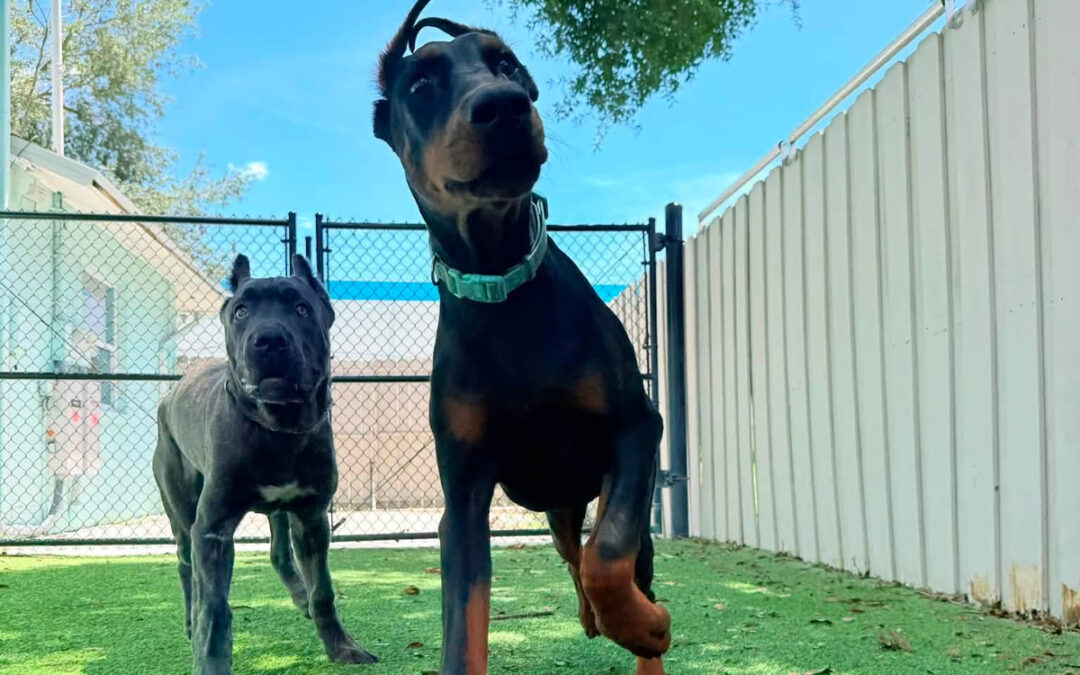
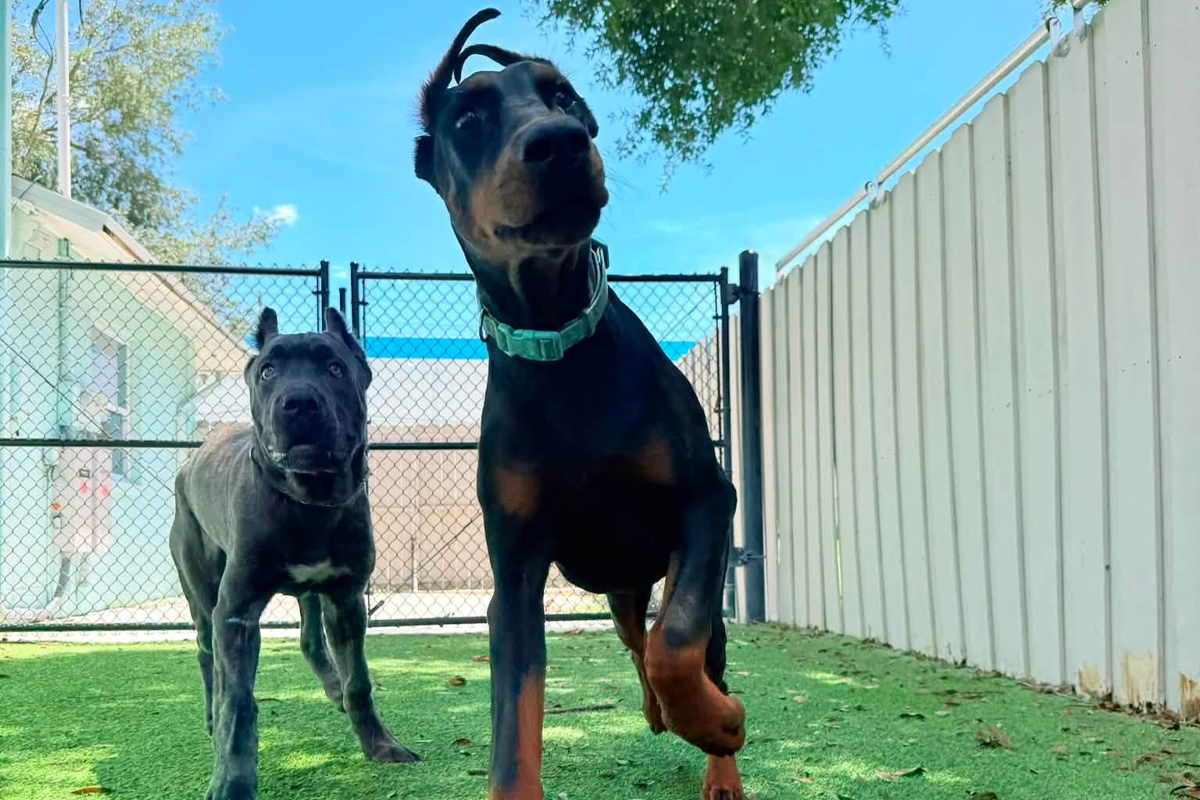
Summer often brings more visitors into the home.
Friends stop by, relatives come into town, children invite people over, and backyard gatherings may keep the house active for hours. For some dogs, every visitor feels exciting. For others, new people create uncertainty. Either way, the result can be the same.
The dog barks, jumps, rushes the doorway, follows guests from room to room, demands attention, or becomes so overstimulated that familiar commands seem to disappear.
This can make even a friendly dog difficult to manage.
The key is not simply trying to calm the dog after they lose control. Better results usually come from giving the dog a clear routine before the visitor enters, maintaining boundaries during the visit, and protecting enough downtime that the dog does not become more overstimulated as the gathering continues. This type of practical household training is an important part of the professional dog training and boarding support families receive from The DogHouse LLC in Pinellas County, Florida.
The Greeting Often Sets the Tone for the Entire Visit
Many guest-related behavior problems begin during the first few seconds.
The dog hears a knock, doorbell, vehicle, or unfamiliar voice and immediately becomes alert. They run toward the entrance, bark, jump, spin, or begin pacing.
Then the door opens.
If the guest responds with excitement, the dog’s emotional level rises even more. The visitor talks to them, reaches down, or encourages the greeting while the dog is already struggling to control themselves.
The dog learns that high excitement is part of the arrival routine.
This can make the rest of the visit much harder.
A dog who begins at maximum intensity may continue pacing, following, barking, and demanding attention long after the initial greeting is over.
Training should begin before the door opens.
Calm Starts Away From the Doorway
The front entrance is often one of the most stimulating areas in the house.
It combines sounds, movement, anticipation, unfamiliar scents, and immediate social interaction. Asking an excitable dog to remain calm directly beside the door may be unnecessarily difficult.
Creating distance can help.
The dog may wait on place several feet away, remain behind a gate, or stay on leash while the guest enters. This gives the visitor space and reduces the dog’s ability to turn the entrance into a physical event.
Distance also allows the dog to observe without immediately interacting.
That brief delay can make a major difference. The guest becomes part of the environment before the dog receives access to them.
Place Work Is One of the Best Tools for Visitors
Reliable place work gives the dog a clear job.
Instead of trying to decide whether to bark, follow, jump, or investigate, the dog has one simple responsibility: remain on the designated bed, mat, or cot.
This structure creates emotional clarity.
The dog can still see and hear what is happening. They are not being excluded from the household. They are simply learning that a visitor does not automatically mean they need to become involved.
Place work should be practiced before a real gathering.
The dog can begin with family members walking around the room. Later, someone can knock, open the door, enter, sit down, and move around while the dog remains in position.
The more familiar the pattern becomes, the easier it is for the dog to use that skill when an actual guest arrives.
The Dog Does Not Need to Greet Immediately
Many dogs lose control because the greeting happens too soon.
The visitor enters, and the dog is released immediately because everyone wants them to say hello. The dog is still emotionally elevated, so the greeting turns into jumping, licking, pawing, circling, or pushing into the person.
Waiting creates a better opportunity.
The dog can remain on place while the guest enters, speaks with the family, and settles into the room. After several minutes, the dog may be much more capable of approaching without overwhelming the visitor.
This delayed greeting also teaches patience.
The dog learns that seeing a new person does not guarantee immediate access.
That lesson becomes especially valuable during busy summer months when visitors may come and go frequently.
Friendly Dogs Can Still Be Too Much
Families sometimes tolerate poor behavior because the dog is friendly.
The dog is not trying to hurt anyone. They are excited.
That does not mean the behavior is appropriate.
A large dog can knock someone over. A smaller dog can scratch legs or jump repeatedly onto furniture beside guests. Some dogs become relentless about licking, pawing, or demanding affection.
Visitors may tolerate the behavior because they do not want to offend the family, even when they are uncomfortable.
Good manners give the guest a choice.
The dog should be able to remain nearby without assuming that every person wants physical interaction.
A friendly dog with boundaries is much easier to include than a friendly dog who cannot control themselves.
Guest Excitement Can Reinforce Jumping Quickly
Jumping becomes especially difficult when visitors respond differently than the family.
At home, the family may be working hard to discourage it. A guest arrives, laughs, pets the dog, or says they do not mind.
From the dog’s perspective, jumping just worked again.
The dog does not understand that the rule changes based on who is entering.
This is why the family should protect the training pattern even when the visitor is comfortable with the behavior.
The dog should earn interaction through calmer behavior.
The guest can be asked to ignore jumping and give attention once the dog has four feet on the floor or is otherwise settled enough to interact appropriately.
Consistency matters more than whether one individual person is bothered by the behavior.
Barking at Visitors Needs a Clear Plan
Some dogs bark because they are excited.
Others bark because they are uncertain, alert, territorial, or uncomfortable with unfamiliar people. The sound may be similar, but the emotional reason can be very different.
This matters when deciding how to respond.
A dog who is demand barking for attention needs different handling from a dog who is worried about the person entering.
Owners should look at the entire picture.
Is the dog moving forward eagerly, or trying to create distance? Are they loose and wiggly, or stiff and watchful? Do they recover once the guest sits down, or remain tense?
Dogs showing intense fear, repeated threatening behavior, or serious aggression around visitors may need a more individualized training and behavior plan.
For dogs whose barking is primarily tied to excitement and weak boundaries, place work, controlled distance, and consistent follow-through can make a meaningful difference.
Guests Should Not Control the Training Routine
Well-meaning visitors can unintentionally make training harder.
They call the dog, pat their legs, offer food, encourage play, or release the dog from place because they want interaction.
The guest is not trying to create a problem.
They simply do not know the rules.
A short explanation before or as they enter is usually enough.
The family might ask the guest to ignore the dog for a few minutes, avoid calling them off place, and wait until the family says the dog is ready to greet.
There is no need to make the visitor responsible for training.
The family should control the dog’s routine and give the guest a few simple instructions that support it.
Summer Gatherings Can Create Too Much Attention
A dog may handle one guest well and struggle with six.
Larger gatherings create more movement, conversation, food, laughter, and unpredictable interaction. People enter different rooms, go outside, return indoors, and greet the dog at different times.
The dog may spend the entire event moving from person to person.
This can create social overstimulation.
At first, the dog seems happy. After an hour, they may become more demanding, start barking, play too roughly, or lose patience when someone stops giving attention.
The number of guests matters.
A dog who succeeds during a quiet visit may still need more structure during a larger gathering.
Outdoor Visitors Create Additional Challenges
Summer visits often move into the backyard or patio.
This adds several more distractions.
The dog may notice food, children, neighboring dogs, wildlife, yard noises, and people moving through gates or doors. The dog may already be excited by the guests, then become even more stimulated by the environment.
Outdoor access should still have rules.
The dog can wait at the door, remain on an outdoor place, and respond to recall. They should not be allowed to rush the fence or become increasingly reactive just because people are outside.
A fenced yard does not eliminate the need for training.
In fact, outdoor social gatherings are often where household manners are tested the most.
Food Can Turn a Manageable Dog Into a Pushy One
Summer gatherings often involve food.
People grill, eat on patios, carry plates through the house, and leave snacks within easy reach. Guests may also be more likely to share with the dog.
A dog that is already excited can become even more persistent around food.
They follow guests, stare, paw, steal, or position themselves beneath children.
Clear food boundaries are especially important during visits.
The dog may stay on place during meals or remain outside the primary eating area. Guests should avoid feeding from plates unless the family has specifically chosen a different routine.
A dog who succeeds once at getting food from a guest may spend the rest of the gathering repeating the behavior.
Children Need More Supervision Around an Excited Dog
Visitors often bring children.
Children may run through the house, shout, hug family members, carry toys, or become excited about seeing the dog. This can quickly raise the dog’s energy.
A dog who is manageable around calm adults may become much harder to control around moving children.
They may chase, jump, bark, mouth clothing, or try to join every game.
Adults should supervise carefully.
The dog may need to remain on place, on leash, or separated until the initial excitement settles. Children should not be responsible for managing the dog’s behavior.
They also should not be encouraged to run from or tease an excited dog.
A calm setup protects both the dog and the children from an interaction that becomes too intense.
Multi Dog Homes Need More Planning
Guest arrivals can become chaotic when several dogs are involved.
One dog barks, and the others join. One rushes the door, and the group follows. The dogs may compete for attention or become physically crowded around the guest.
Group excitement can make individual obedience disappear.
The family may need to manage the dogs separately.
One dog can greet while another remains on place. Separate gates, crates, leashes, or rooms may be useful during the entrance.
Not every dog needs to participate at the same time.
Individual control is more important than trying to create a group greeting simply because everyone is excited.
Practice With People the Dog Already Knows
Training becomes much easier when the first practice sessions are predictable.
A familiar friend or family member can help create mock arrivals. They can knock, wait while the dog goes to place, enter calmly, sit down, and interact only when directed.
This allows the family to rehearse the entire routine.
The dog learns that the knock does not mean rushing. The door opening does not mean immediate greeting. The visitor sitting down does not mean place is over.
These repetitions are extremely valuable because they remove some of the uncertainty from future arrivals.
Real guests become less novel when the dog already understands the pattern.
Do Not Make the Practice Too Difficult Too Fast
Owners sometimes practice once with one calm visitor and then expect the dog to succeed during a large party.
That is a major jump in difficulty.
Training should progress gradually.
One guest may become two. A short visit may become longer. The dog may practice while people move around, carry food, or go outside.
Each new challenge should build on skills the dog already understands.
If the dog repeatedly breaks place, barks continuously, or becomes too excited to respond, the situation may be too difficult.
Reducing the intensity creates more successful learning than allowing the dog to fail repeatedly.
Leash Guidance Can Provide Extra Control
Some dogs benefit from remaining on leash during the beginning of a visit.
This gives the family a practical way to prevent jumping, rushing, or unwanted following while the dog is still learning.
The leash should not become a constant wrestling match.
It is simply an additional layer of control while the dog practices better choices.
A dog who is unable to remain calm with full freedom may not be ready for that freedom yet.
As behavior improves, the family can gradually reduce management.
Do Not Let the Dog Follow Guests Everywhere
Some dogs become fixated on visitors.
They follow them to the kitchen, bathroom, patio, or hallway. Every time the guest stands, the dog stands too.
This may look friendly, but it can prevent the dog from settling.
The visitor becomes the center of the dog’s attention.
Place work or another clear boundary helps break that pattern.
The dog should be able to remain settled while the guest moves through the house. They do not need to supervise or escort every person.
This is an important part of teaching emotional independence around visitors.
Excitement Often Returns When Guests Move
A dog may finally settle after the greeting, then become excited again the moment the visitor stands.
Movement predicts something new.
The guest may be leaving, going outside, carrying food, or walking toward another room. The dog gets up, follows, or starts barking again.
These transitions need training too.
The dog may return to place while people move. They may wait while doors open or remain settled as guests prepare to leave.
Many dogs do well once everyone is seated and struggle when the environment changes.
Reliable visitor manners need to work through the entire visit, not only during the first greeting.
The Dog Does Not Need to Participate in Everything
Some families feel guilty separating the dog during part of a gathering.
There is nothing wrong with giving the dog a break.
A summer visit may last several hours. The dog does not need to remain socially engaged the entire time.
A quiet crate, separate room, or protected resting area can help the dog recover.
This is especially useful when children become more active, people begin eating, or the dog starts showing signs of overstimulation.
Giving the dog rest before they lose control is much more productive than waiting until behavior has already deteriorated.
Learn the Dog’s Early Signs of Overstimulation
Families often notice the problem only after the dog begins barking, jumping, or ignoring commands.
There may have been earlier signs.
The dog starts pacing, panting more, following guests more closely, scanning the room, responding slowly, or repeatedly leaving place.
These changes suggest that self-control is becoming harder.
Recognizing them early allows the family to intervene.
The dog can take a break, return to place, or move to a quieter area before the behavior becomes difficult.
Prevention is usually easier than trying to regain control after the dog has crossed their limit.
Rest Matters More Than Many Owners Realize
A dog can enjoy visitors and still become tired from them.
Social interaction requires mental effort. The dog is processing smells, movement, voices, body language, food, and household changes.
Long visits can gradually reduce patience.
A dog that greeted beautifully may become pushier two hours later simply because they are tired.
Protected rest can prevent this.
A dog who receives a meaningful break may return to the gathering much calmer than one who has been trying to manage the environment nonstop.
Calm Behavior Should Create Access
Dogs repeat behaviors that produce results.
If jumping creates attention, jumping remains valuable. If barking makes a guest approach, barking continues to work.
The family should create the opposite pattern.
Calm behavior leads to greeting. Waiting leads to release from place. Respectful behavior allows the dog to remain near the guests.
This does not require rewarding every quiet second.
It means making sure the behavior the family wants is the behavior that consistently moves the interaction forward.
Avoid Repeating Commands Through the Entire Visit
Busy gatherings can turn owners into constant narrators.
“Sit.”
“Stay.”
“Leave it.”
“Get down.”
“Go to place.”
“Stop.”
If the dog continues ignoring repeated commands, those words gradually lose importance.
Management can be more effective.
A leash, gate, place cot, or crate gives the family a practical way to support the expectation instead of repeating it endlessly.
Clear, consistent guidance usually creates a calmer atmosphere than constant verbal correction.
Visitor Manners Need Household Consistency
One person cannot maintain the entire training routine if everyone else is undoing it.
Family members need to agree on the basic rules.
The dog does not rush the door. Jumping does not create greetings. Place remains place until the dog is released. Food does not come from begging.
Children and frequent visitors may need reminders too.
When the expectations remain consistent, the dog spends less time testing and more time following the familiar pattern.
Better Visitor Manners Create More Freedom
Structure may feel restrictive at first, but it usually leads to more freedom.
A dog that can greet calmly, settle near guests, respect food boundaries, and respond around movement can remain part of the gathering.
A dog who continually jumps, steals food, rushes doors, or overwhelms visitors often ends up being removed completely.
Training creates a middle ground.
The dog can participate because they have the skills needed to do so responsibly.
That makes visits more enjoyable for the dog, the family, and the guests.
Board-and-Train Can Help Build Stronger Visitor Behavior
Some dogs struggle with visitors in several ways at once.
They bark at the door, rush the entrance, jump, ignore place, follow guests, demand attention, and become increasingly overstimulated as the visit continues.
These behaviors often share a common foundation.
The dog has weak impulse control, unclear boundaries, and difficulty transitioning from excitement back into calmness.
A structured board-and-train program can help build those underlying skills.
The dog receives consistent practice with place work, doorway manners, greetings, leash guidance, waiting, impulse control, and calm transitions. They learn that visitors can enter and move through the environment without every moment requiring their involvement.
The family also receives guidance on continuing the same expectations at home.
This follow-through is essential because visitor manners become reliable only when the household maintains the structure during real social situations.
Training a dog to handle summer visitors without losing control begins before the guest walks through the door.
Excitement can build quickly around knocking, movement, new voices, children, food, outdoor activity, and repeated interaction. Without enough structure, even a friendly dog can become overwhelming and difficult to manage.
The solution is not to remove the dog from every visit.
It is to teach them how to participate more successfully. Place work, doorway manners, delayed greetings, clear food boundaries, supervised interactions, calm transitions, and protected rest all help the dog understand what is expected.
From our perspective, the best visitor behavior is not a dog who shows no excitement. It is a dog who can feel that excitement and still remain responsive, respectful, and capable of settling as the visit continues.
Contact The DogHouse LLC to learn how a structured board-and-train program can help your dog develop calmer greetings, stronger impulse control, and more reliable behavior around summer visitors in Pinellas County, Florida.