


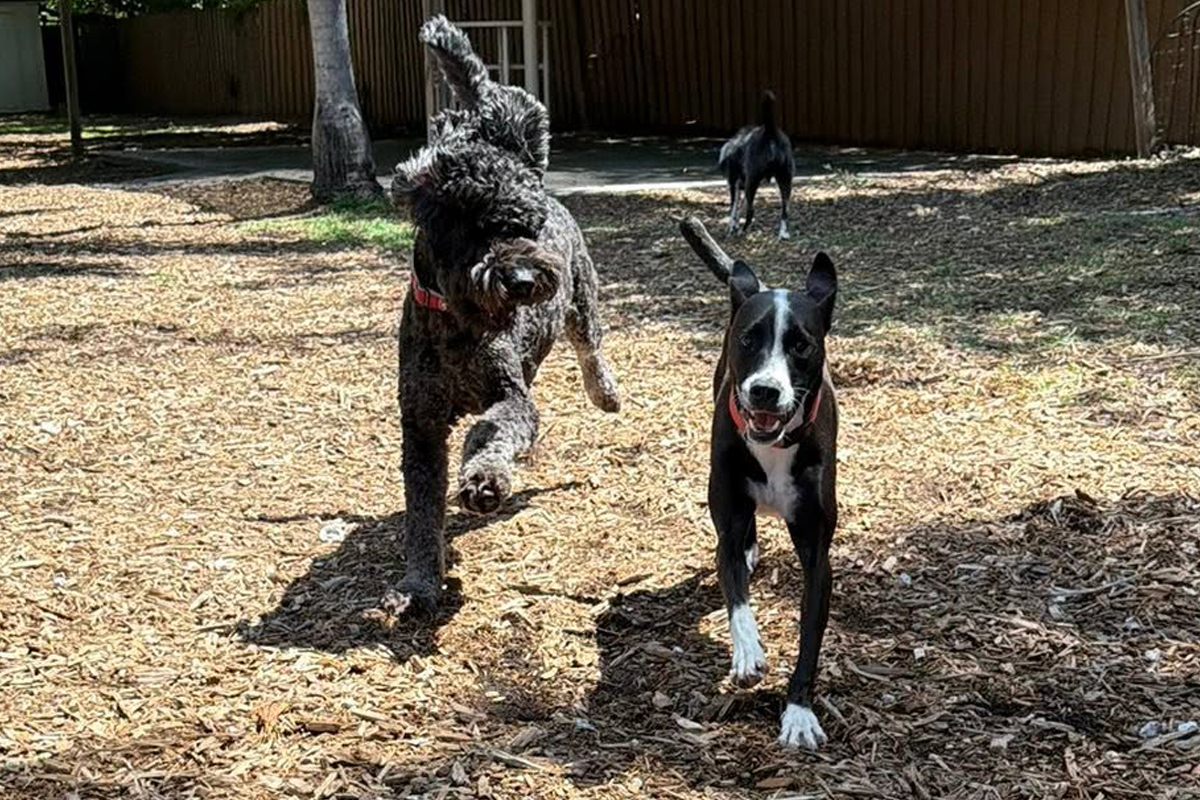
Living with more than one dog can be incredibly rewarding, but it can also become overwhelming faster than many owners expect.
A lot of people imagine that adding another dog will automatically create more companionship, more play, and more balance in the home. Sometimes it does. But in many households, what actually happens is that the dogs begin feeding off each other’s emotional state. One dog gets excited, and the other rises with them. One dog gets tense, and the room changes. One bark turns into three. One restless dog can make the whole house feel unsettled. What looks like separate behavior problems is often one shared emotional pattern building momentum between the dogs.
That is why multi-dog homes can feel so different from homes with just one dog. Energy moves faster. Excitement gets bigger. Stress spreads more easily. And without enough structure, it can start feeling like the dogs are constantly setting each other off. That is exactly why this issue matters so much for families working toward a calmer home with The DogHouse LLC.
Dogs Are Constantly Reading Each Other
One of the biggest things owners underestimate is how much dogs are paying attention to each other all day long.
Dogs do not live side by side the way people do. They are constantly reading movement, posture, intensity, hesitation, arousal, and changes in the environment through the behavior of the other dogs around them. If one dog hears something outside and becomes alert, the others notice immediately. If one dog rushes the door, the others often feel compelled to join. If one dog becomes anxious, possessive, reactive, or overstimulated, that emotional shift rarely stays contained.
This is one of the reasons multi-dog households can feel emotionally crowded. The dogs are not only responding to the world. They are responding to each other’s response to the world. That creates a kind of chain reaction that can make even simple moments feel much bigger than they would with one dog alone.
Excitement Spreads Fast in a Shared Space
Excitement is one of the easiest things for dogs to share.
A leash comes out, and suddenly all the dogs are up. Someone pulls into the driveway, and the whole house changes. One dog starts running toward the back door, and the others are immediately in motion. Guests arrive, dinner is being prepared, toys come out, or someone stands up from the couch, and before long the entire room feels charged.
This is why owners often say things like, “They are fine until one of them starts,” or “Once one gets going, they all do.”
That pattern is real. Dogs often take emotional cues from each other, especially in homes where routines are loose and boundaries are not very clear. The more often they rehearse this pattern, the more automatic it becomes. Over time, they stop needing a big reason to get worked up. They learn that group excitement is simply what happens in that environment.
Stress and Tension Spread Too
It is not just excitement that travels between dogs. Stress does too.
If one dog is nervous around guests, sensitive to sounds, protective of space, frustrated on leash, or unsettled by movement in the home, the others often begin reacting to that tension as well. They may not fully understand the trigger, but they understand that something has changed. They see the posture shift, the alertness rise, the movement intensify, and they respond to it.
That is one of the reasons some homes feel tense even when nothing obvious is happening. The dogs are carrying low-level emotional pressure that keeps bouncing between them. One dog may be the spark, but the whole group becomes part of the pattern.
In my experience, this is especially common in homes where one dog is more confident, loud, or reactive and the others have learned to follow that emotional lead. Over time, the household starts feeling like it is always only one small trigger away from noise, chaos, or overstimulation.
The Problem Usually Is Not the Relationship Itself
A lot of owners assume that if dogs are feeding off each other’s energy, the problem must be that the dogs should not be together.
Sometimes there are deeper compatibility issues, but more often the real problem is that the home lacks enough structure to interrupt the emotional momentum between them.
Dogs can love each other, enjoy each other, and still create chaos together.
That is an important distinction.
The issue is usually not that the dogs are bonded. It is that they are bonded without enough calm, clear rules around how to move through everyday life. If greetings are wild, doors are rushed, barking is contagious, and excitement is constantly reinforced, the dogs begin building a shared habit of emotional escalation. What starts as companionship becomes group overreaction.
That is why structure matters so much. It helps the dogs stay together without letting their shared energy run the whole house.
Multi-Dog Homes Need More Boundaries, Not Fewer
One of the biggest mistakes people make in multi-dog homes is assuming the dogs should simply work things out on their own.
Sometimes owners hesitate to intervene because they do not want to disrupt the dogs’ natural relationship. But in many homes, the kindest thing you can do is create stronger boundaries around the moments where energy tends to build.
That may mean calmer doorway routines, more intentional greetings, structured feeding, place work when guests come over, more control around windows or fences, and less freedom to rush every moment together. It may mean separating dogs during high-arousal moments or making sure they are not constantly rehearsing the same group reactions.
Boundaries do not weaken the dogs’ relationship. In many cases, they make it much healthier. They lower pressure, reduce conflict, and help each dog stop depending so heavily on the emotional current created by the others.
Calmness Has to Be Practiced as a Group and as Individuals
One thing I have found over and over again is that multi-dog households improve fastest when owners work on both sides of the problem.
Each dog needs individual accountability, and the group needs a calmer shared routine.
If each dog cannot settle on their own, group calmness is very hard to achieve. If one dog never learns to pause, the others often keep getting pulled into that same intensity. But if the whole group is only trained individually and never learns how to exist calmly together, the shared household energy can still stay too high.
That is why real progress usually comes when dogs learn both how to regulate themselves and how to remain steady in each other’s presence. The house begins to feel different when one dog can get up without all of them popping up, when one dog can hear a sound without creating a full-room reaction, and when one dog’s excitement no longer automatically becomes everybody’s problem.
Better Structure Changes the Feel of the Whole Home
When dogs stop feeding off each other’s energy so intensely, the whole atmosphere of the home changes.
The barking comes down faster. Greetings feel less chaotic. Guests become easier. Daily transitions feel smoother. Owners stop feeling like they are always bracing for the group reaction. The house gets quieter, but more importantly, it feels steadier.
That is the part many owners do not realize they are missing until it starts returning.
A multi-dog home does not have to feel loud, tense, or emotionally crowded all the time. Dogs can absolutely live together with more calm, more patience, and more emotional balance. But in most cases, that does not happen by accident. It happens because the routines, expectations, and boundaries around them finally start making calmness easier than chaos.
Board-and-Train Can Help Interrupt the Pattern
This is one of the reasons board-and-train can be so helpful in multi-dog homes.
When dogs have spent months or years rehearsing shared overarousal, shared barking, shared tension, or shared impulsiveness, the pattern usually needs more than small corrections in the moment. It needs a reset. A strong training program helps build better individual habits first, then creates a stronger foundation for those dogs to come back into the home with more clarity and more control.
Instead of each dog continuing to fuel the same pattern, they begin returning with better settling skills, stronger obedience, clearer boundaries, and more emotional stability. That often makes it much easier for the whole household to shift into a calmer rhythm.
When dogs feed off each other’s energy, the issue is rarely just noise or excitement on the surface. It is usually a sign that the emotional rhythm of the home has become too reactive, too fast, and too dependent on whatever one dog feels first.
The good news is that this can change.
With better structure, clearer routines, stronger boundaries, and enough consistency, dogs can learn to live together without amplifying every spark into a bigger problem. And when that happens, a multi-dog home starts feeling much more peaceful, manageable, and enjoyable for everyone in it.
Contact The DogHouse LLC to learn how a structured board-and-train program can help your dogs build calmer habits, stronger individual behavior, and a more stable household rhythm together.